

Graduation without regular college- Education Options for Working Students Who Can’t Attend College Daily
Graduation without regular college- Education Options for Working Students Who Can’t Attend College Daily
Graduation without regular college– A few years ago, the idea of completing graduation without attending a regular college was almost unthinkable. Education followed a rigid structure: attend classes daily, follow fixed schedules, and put everything else on hold. If you couldn’t do that, the system quietly pushed you out.
And many people were pushed out.
Students dropped out not because they lacked ability, but because life didn’t pause for college. Some had to work. Some had family responsibilities. Others simply couldn’t afford the cost — financially or physically. For a long time, there were only two choices: struggle through regular college or quit altogether.
That reality has changed. And ignoring that change is what keeps people stuck.
Then vs Now: How the System Used to Break Students
Earlier, students who couldn’t attend regular college had no real alternatives.
If you worked full-time, you either:
- Missed classes constantly
- Juggled exhausting schedules
- Or dropped out midway due to burnout
Many students tried to do everything at once — college in the morning, work in the evening, travel in between — until exhaustion caught up. The result was predictable:
- Poor academic performance
- Declining health
- Mounting stress
- And eventually, dropping out
On top of that came hefty financial pressure. Regular college meant:
- High tuition fees
- Accommodation or relocation costs
- Daily travel expenses
- Hidden academic and examination fees
For middle-class families, this often translates into loans or long-term financial strain. And if the student dropped out midway, the cost didn’t disappear — the debt stayed.
The system wasn’t designed for flexibility. It was designed for conformity.
The Shift: Education Adapted to Real Life (Not the Other Way Around)
Over time, regulators and institutions acknowledged a hard truth:
A single rigid education model doesn’t work for everyone.
This led to the expansion of:
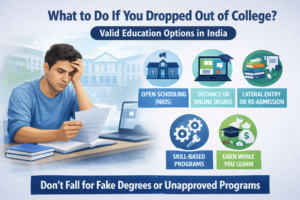
- Distance education
- Online degree programs
- Open learning pathways
These were not created as shortcuts. They were created as structured alternatives for students who needed flexibility without losing legitimacy.
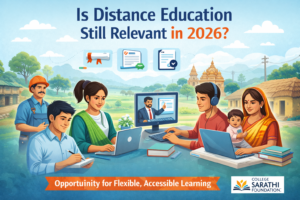
Today, graduation without regular college is not only possible — it is recognized, regulated, and increasingly common.
Valid Ways to Graduate Without Regular College
1. Distance Education (UGC-Recognized)
Distance education allows students to study without daily campus attendance. Learning happens through:
- Printed or digital study materials
- Periodic assignments and exams
- Optional academic support sessions
This mode suits students who:
- Prefer self-paced learning
- Have work or family responsibilities
- Want lower costs without sacrificing degree validity
As long as the university and program are recognized, the degree holds legal value.
2. Online Degree Programs
Online degrees are more structured and interactive than traditional distance learning. They typically include:
- Live or recorded classes (3–4 times a week)
- Digital platforms for learning and assessments
- Faculty interaction without physical presence
This model fits students who want guidance but can’t commit to daily college travel.
3. Open Learning & Second-Chance Pathways
For students with academic gaps or incomplete schooling, open systems provide a way back. Once eligibility is restored, students can:
- Enroll in graduation programs
- Resume education without age barriers
- Rebuild academic continuity legally
This matters because education gaps should not permanently limit someone’s future.
The Financial Reality (This Is Where Most People Get It Wrong)
Let’s be blunt.
Regular college is expensive — not just in fees, but in opportunity cost.
When you attend a full-time college:
- ou attend a full-time college:
- You lose working hours
- You delay income generation
- You depend longer on family support
Online and distance programs, in comparison:
- Cost significantly less in tuition
- Eliminate relocation and travel expenses
- Allow students to earn while studying
Over three years, this difference becomes massive.
A student who studies online while working:
- Pays lower fees
- Gains real work experience
- Avoids education loans or minimizes them
This is not “cheap education.”
This is financially rational education.
The Career Advantage Nobody Talks About
There’s a misconception that regular college automatically leads to better careers. That’s outdated thinking.
In reality, employers value:
- Practical experience
- Skill application
- Consistency and progression
When a student works a proper job while attending online classes:
- They apply learning immediately
- They build professional maturity early
- They graduate with both a degree and experience
Compare that to someone who:
- Finishes regular college
- Then starts job hunting with no experience
Who is actually more employable?
For many roles, experience + degree beats degree alone.
Is This Path Valid for Jobs and Higher Studies?
Is online graduation valid in India. Yes — if done correctly.
What matters:
- University recognition
- Program approval
- Eligibility compliance
What doesn’t matter:
- Whether classes were physical or online
- Whether attendance was daily or flexible
Degrees earned through recognized online or distance modes are accepted for:
- Private sector jobs
- Government positions (subject to eligibility norms)
- Post-graduation programs
Invalid degrees come from wrong guidance, not from flexible learning itself.
Where Most Students Go Wrong
The problem is not alternative education.
The problem is misinformation.
Students often:
- Enroll in unverified programs
- Trust agents without checking approvals
- Choose based on cost alone
That’s where damage happens.
How College Sarathi Foundation Fits In
College Sarathi Foundation focuses on education continuity and correction, especially for:
- Dropouts
- Working learners
- Students confused by conflicting advice
The role is not to push admissions blindly, but to:
- Explain which options are valid
- Match pathways to individual backgrounds
- Prevent irreversible academic mistakes
Guidance matters more than speed.
Final Reality Check
If you believe regular college is the only respectable way to graduate, you’re holding onto an outdated belief — and paying for it with delay, stress, or inaction.
Graduation without regular college is not a compromise.
It’s a strategic alternative — when chosen correctly.
Education should support your life, not exhaust it.

About author


Add comment
You must be logged in to post a comment.